Master Block Craft
- 3.5
- Rating
- 1.00M
- Installs
- Free
- Price
 Analysis by App-foxy
I approached Master Block Craft as a compact adventure game rather than expecting a tightly scripted campaign. Its appeal is the freedom to decide what matters next: staying safe, exploring, building, crafting, or working toward a more comfortable base. That open-ended mix makes it easy to start for a few minutes and then keep playing because one small task naturally leads to another.
Developed by Darkhound Games, this free game is aimed at players aged Everyone 10+ and runs on Android devices using version 5.0 or later. It has passed the one-million-install mark, while its average score sits at 3.5 from roughly ten thousand ratings. Those numbers suggest a broad audience, but also a divided response, which matches my experience: the basic idea is approachable, yet the loose structure and uneven sense of progress will not suit everybody.
How the first goals shape the adventure
The opening strength is that I am not forced into a single objective. The world presents several useful directions at once. I can look for materials, establish a place to return to, experiment with construction, or move farther out to see what the environment offers. That choice gives the first sessions a pleasant sense of ownership because my priorities affect how the game feels.
You May Also Like

 Blood Strike: 2.5 Anniversary
Blood Strike’s Loadouts Turn Every Drop Into a Tactical Gamble
A close look at Blood Strike’s custom loadouts: how fast access to signature weapons reshapes its battle royale rhythm, rewards preparation, and narrows the gap between fights.

 Pandora - Music & Podcasts
Pandora’s Music Is Easy to Start, but Harder to Recover
Pandora’s strength is its low-effort path from a seed to a station. Its weak spot is how much confidence it asks you to place in connection, setup, and quiet recovery.

 8 Ball Pool
 Is Built on Rivalries, Rematches, and Routine
A close look at the rivalries, rematches, shared routines, and unanswered safety questions that turn a quick pool match into a persistent mobile community.

 Samsung Music
’s Quiet Strength Is Playing What You Already Own
Its reach comes less from spectacle than from dependable access to a personal library. That simplicity is both the app’s strongest retention engine and its ceiling.

 AccuWeather: Weather Radar
AccuWeather Review: A Quick, Clear Forecast for Everyday Decisions
For everyday plans, the best forecast is the one you can understand quickly. AccuWeather makes rain timing, radar, and local conditions easy to act on, with a few trade-offs.

 Hill Climb Racing
Why Hill Climb Racing Still Turns Crashes Into One More Run
A tiny car, a bumpy hill and one more upgrade: Hill Climb Racing keeps resurfacing because its simple chaos makes every near-miss feel personal.
More From Our News Desk
View All News


For a new player, I recommend treating the first base as a practical workshop instead of trying to make it beautiful immediately. A small, organized shelter is more useful than a large decorative project when resources are still limited. I found it easier to separate storage, crafting space, and farming activity mentally, even when the surroundings remained simple. That arrangement reduces wandering and makes each return from exploration feel productive.
The survival angle also gives ordinary actions a reason. Gathering is not just busywork when it supports shelter, tools, food, or the next trip. Farming can become a steady background task while I focus on construction or exploration. The important point is to choose one short-term target before setting off. Without that decision, the open world can turn into aimless movement, especially when I am still learning which materials deserve attention.
The most effective early routine is a loop, not a checklist: prepare, travel, collect, return, improve, and then extend the range of the next trip. This rhythm makes the game easier to understand than trying to master every activity at once. It also protects the experience from becoming a sequence of disconnected chores.
Building with a purpose
Construction is most satisfying when it solves a problem. A shelter that marks a useful stopping point, a farm placed close enough to revisit, or a storage area arranged around frequent materials has more value than a structure created only to fill space. Players who enjoy designing elaborate buildings may eventually want more creative freedom, but the practical side of building is where I felt the clearest connection between effort and progress.
I also learned not to overcommit to a grand plan too soon. Early resources are better spent on a base that can be expanded than on a finished-looking project that becomes awkward once my needs change. This is a subtle trade-off: decoration creates immediate satisfaction, while functional construction makes later exploration less frustrating. For me, combining the two worked best—keep the core compact, then add visual details after the routine feels stable.
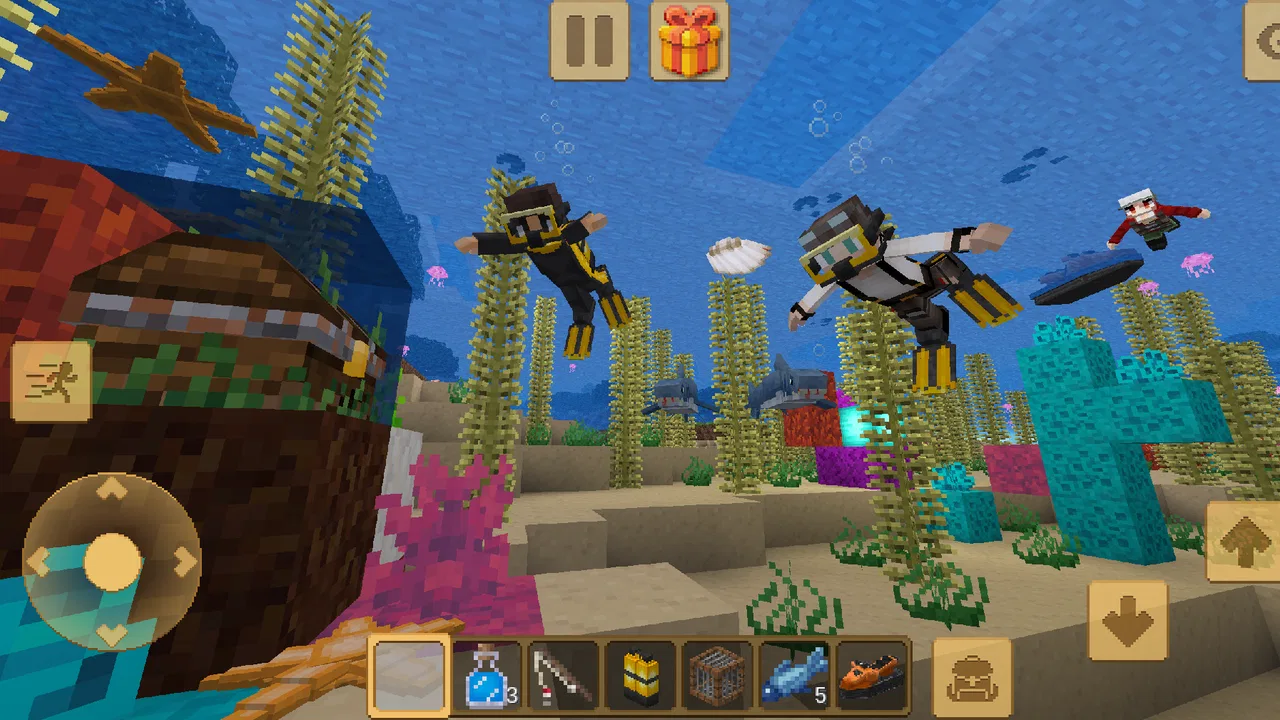
The game’s block-based presentation makes experimentation approachable. Mistakes do not feel as intimidating as they would in a more realistic building game, and the visual language is easy to read. On the other hand, players seeking highly detailed construction tools or a strongly guided architectural system may find the experience too relaxed. Its pleasure comes from making a personal place in a flexible world, not from delivering a professional design sandbox.
Progress signals, unlocks, and the feeling of moving forward
Because the adventure is open-ended, progress is often something I create rather than something announced with a dramatic story beat. A better shelter, a more reliable supply of materials, a farm that supports longer trips, and access to areas I could not comfortably handle before all act as personal milestones. These signals are quieter than a traditional level-based campaign, but they can be more meaningful when I remember exactly why I built or gathered something.
This design works especially well for players who enjoy setting their own goals. Someone might decide to improve the base, while another player may care more about seeing what lies beyond familiar ground. The same world can therefore support different play styles without demanding that everyone follow one route. I appreciated that flexibility during shorter sessions because even a modest task could contribute to a larger plan.
The trade-off is that the game does not always create enough urgency for players who need constant rewards. If I stop paying attention to my own objectives, the activities can blur together. Gathering, crafting, farming, and building are individually understandable, but their value depends on how I connect them. I would not recommend this as the first choice for someone who wants a clearly marked chain of missions, frequent story revelations, or a strong achievement ladder.
My practical advice is to keep a mental “next upgrade” list with three levels: something useful now, something that expands options, and something purely enjoyable. For example, I might first improve storage, then prepare for a longer expedition, and finally decorate the base. This prevents the survival tasks from taking over while also keeping the creative side alive. It is a simple way to create the progression signals that the open format does not always provide automatically.
Why the progression can feel personal
The best moments arrive when an earlier decision pays off later. A base placed near useful resources saves time. A farm maintained before a long journey reduces preparation pressure. Materials gathered with a specific project in mind make construction feel earned rather than random. These connections are easy to miss if I rush from one activity to another, so the game rewards a little planning more than constant speed.
There is also a useful distinction between unlocking something new and becoming better prepared. Exploration may reveal a new direction, but preparation determines whether that direction feels manageable. This makes progress less about a single reward and more about improving the quality of each future decision. I found that satisfying, although players who prefer visible unlock screens may consider it under-explained.
For everyday play, the format suits a short evening session. I can decide to gather one category of material, make a small improvement, or tend to the farm without needing to remember a complex plot. A longer session becomes more enjoyable when I begin with a destination and return before the trip becomes an unplanned detour. That structure keeps the game relaxing rather than turning it into repetitive wandering.
Difficulty, pacing, and where friction appears
The difficulty curve feels closely tied to preparation. The game is easiest when I stay near familiar resources and keep my base organized. It becomes more demanding when I travel farther, carry more valuable materials, or attempt a project that requires several kinds of preparation. That is a sensible curve for a survival-adventure format because the challenge grows from the choices I make, not only from a fixed sequence of stages.
Still, the pacing can feel uneven. A productive session may contain several small victories, while another may be dominated by collecting materials without an obvious payoff. The difference usually comes down to whether I started with a concrete purpose. When I played without one, the game seemed slower than it really was. When I planned around a building improvement or an expedition, the same activities felt connected.
This is where the game differs from more traditional adventure alternatives. A story-driven adventure normally supplies momentum through objectives, dialogue, and set-piece moments. A focused crafting game may offer deeper specialization in building or resource management. Master Block Craft sits between those styles: it provides more freedom than a linear adventure, but less external direction than a mission-heavy game. Its strength is the blend; its weakness is that the player must supply much of the motivation.
Players should also consider their tolerance for repetition. Gathering and farming are useful because they support other activities, but they can become routine if I repeat them without changing the goal. I found that alternating between construction and exploration helped. After a resource-focused session, I would return to the base and make a visible improvement. After building, I would travel again so the new space had a practical purpose.
The key difficulty-management tip is to expand gradually. Extending the base, increasing storage, and preparing supplies before exploring farther creates a smoother experience than treating every new area as an immediate challenge. This approach does not remove the game’s friction, but it turns uncertainty into a manageable planning problem.
Who will enjoy the slower rhythm
I would recommend it to players who like Minecraft-style ideas but want a straightforward, free mobile adventure centered on survival, exploration, crafting, farming, and building. It is also a good fit for someone who enjoys making a small world feel personal over several sessions. The Everyone 10+ rating makes it accessible to a broad family audience, although younger players may still benefit from guidance when learning how to prioritize resources.
I would be more cautious recommending it to players who need polished competitive balance, a deep narrative, or a carefully paced campaign. It is not the right choice if the main attraction is fast combat, constant spectacle, or a clearly defined ending. Likewise, players who dislike gathering loops may lose interest once the novelty of the block-based world fades.
Retention pressure and the reason to return
The strongest reason to come back is the unfinished personal project. A half-built shelter, an unexplored direction, or an underdeveloped farm creates a natural invitation to continue. This kind of retention is gentler than a system built around constant rewards. I return because I want to see my own plans take shape, not because every session has to deliver a major revelation.
That approach can be calming, but it also means the game has to compete with the player’s attention in a quieter way. If I do not have a project in mind, there may be little pressure to start another session. The experience is therefore strongest when I leave myself a clear next step before closing it. Even a note such as “collect materials for the storage area” can make the next launch feel purposeful.
Another useful habit is to maintain two kinds of goals at once. A practical goal keeps the survival side moving, while a creative goal prevents the routine from becoming purely functional. I might prepare supplies for exploration and then reshape part of the base when I return. This balance is more sustainable than focusing only on efficiency, because the building side provides visible evidence of time well spent.
The game’s free price lowers the barrier to trying this rhythm, and its current version is 1.6.1. I would still approach it with realistic expectations: free access makes experimentation easy, but it does not change the underlying design. If the open-ended loop does not appeal during the first sessions, additional time is unlikely to transform it into a story-led adventure.
How it compares with familiar alternatives
Compared with a conventional adventure game, this one offers less narrative direction but more control over the shape of each session. Compared with a pure creative building game, survival, farming, and resource preparation give construction a stronger practical context. Compared with a focused farming title, exploration and block-based building make the world feel less centered on one routine.
That middle position is both its identity and its limitation. I liked having several activities available, but none of them felt as specialized as they might in a game built around only one idea. If building is your priority, a dedicated creative sandbox may offer more depth. If farming is the main attraction, a farming-focused alternative could provide a clearer long-term structure. Master Block Craft makes more sense when you specifically want the combination.
A realistic use case is a player with irregular free time who wants a world that can be advanced in small pieces. A ten-minute session can involve tending the farm or organizing materials, while a longer session can support exploration and construction. The game does not require every visit to be an expedition, which makes it easier to fit around school, work, or other daily responsibilities.
My progression verdict
Master Block Craft succeeds when I treat it as a self-directed adventure with survival tools, not as a conventional campaign with a fixed reward schedule. Its early goals are flexible, its progress is visible through the world I create, and its challenge grows mainly from how far I choose to push preparation and exploration. That structure gives the game a friendly, personal quality.
Its main weakness is equally clear: the pacing depends heavily on the player. Without a project, gathering and crafting can feel repetitive; without patience, the quiet progress signals may seem too small. The average score of 3.5 reflects why the game can appeal strongly to one player and feel underdeveloped to another. I would not call it a universal recommendation, but I would suggest trying it if you enjoy setting your own goals.
After playing, my preferred approach is simple: build a modest base, organize it around actual routines, keep farming as support rather than a distraction, and explore only after preparing for the trip. Then use each return to create one practical improvement and one personal touch. That method brings out the best balance between survival, creativity, and discovery.
For a free adventure game from Darkhound Games, it offers a generous range of activities and a clear identity built around making progress at your own pace. I would recommend it to patient players who want a flexible mobile world and are comfortable supplying their own direction. If you need a strong story, constant unlocks, or a sharply escalating challenge, choose a more structured alternative instead. If you want to shape a small block-based world through repeated, manageable decisions, Master Block Craft is worth a try.
FAQs for Master Block Craft
01What is Master Block Craft and how does it work?
Master Block Craft is a sandbox building game available for Android and iOS devices. It allows players to create and explore their own virtual worlds with a variety of tools and materials. Using simple controls, you can build structures, mine resources, and interact with various elements within the game. It offers a creative mode for limitless building and a survival mode with challenges.
02Is Master Block Craft free to play, and are there in-app purchases?
Yes, Master Block Craft is free to download and play. However, the game does offer in-app purchases that can enhance the gameplay experience. These purchases may include additional resources, special tools, or cosmetic items to customize your character or world. While optional, they provide additional convenience and personalization options.
03What are the system requirements for Master Block Craft?
To run Master Block Craft smoothly, your device should meet certain specifications. For Android, it typically requires Android version 5.0 or higher. For iOS, the game usually supports devices running iOS 10.0 or later. Adequate storage space and a stable internet connection are recommended for the best experience, especially for updates and online features.
04Can I play Master Block Craft with friends?
Yes, Master Block Craft offers a multiplayer mode where you can collaborate with friends to build and explore together. You can join public servers or create private ones to enjoy a shared experience. This feature enhances the social aspect of the game, allowing for cooperative or competitive play with your friends.
05Are there any parental controls in Master Block Craft?
Master Block Craft includes basic parental controls to ensure a safe gaming environment for younger players. Parents can manage in-app purchases and monitor multiplayer interactions. It's recommended to review the game's settings and discuss online safety with children to ensure a secure and enjoyable experience. Always supervise gameplay to prevent unauthorized purchases.
Pros
- Intuitive controls for easy gameplay.
- Vibrant graphics enhance user experience.
- Frequent updates with new features.
- Multiplayer mode adds social interaction.
- Offline mode available for play anywhere.
Cons
- Occasional in-app ads can be intrusive.
- Limited building materials in free version.
- Some features locked behind paywall.
- Requires significant storage space.
- Performance lags on older devices.

Master Block Craft
Gallery